
See motion in context
Combine position and heading with IMU measurements to display vessel movement, orientation and planned-versus-measured routes.
SIMULATION & VESSEL INTEGRATION
A digital view of vessel movement, sensor observations and operating state—for mission preparation, supervision and review.
Today: visual simulation and a separate indoor Marine Awareness System prototype. Live vessel integration is proposed.
Watch the 30-second Ghent simulation: AVATAR III leads while AVATAR II follows its track. The dashed amber line is the planned route; cyan and purple lines show the simulated vessel tracks. This demonstration uses simulated motion, with live vessel and sensor integration proposed.
FROM THE SIMULATION WORK
Actual development captures of the port and bridge scenarios. Vessel geometry and behaviour are illustrative.
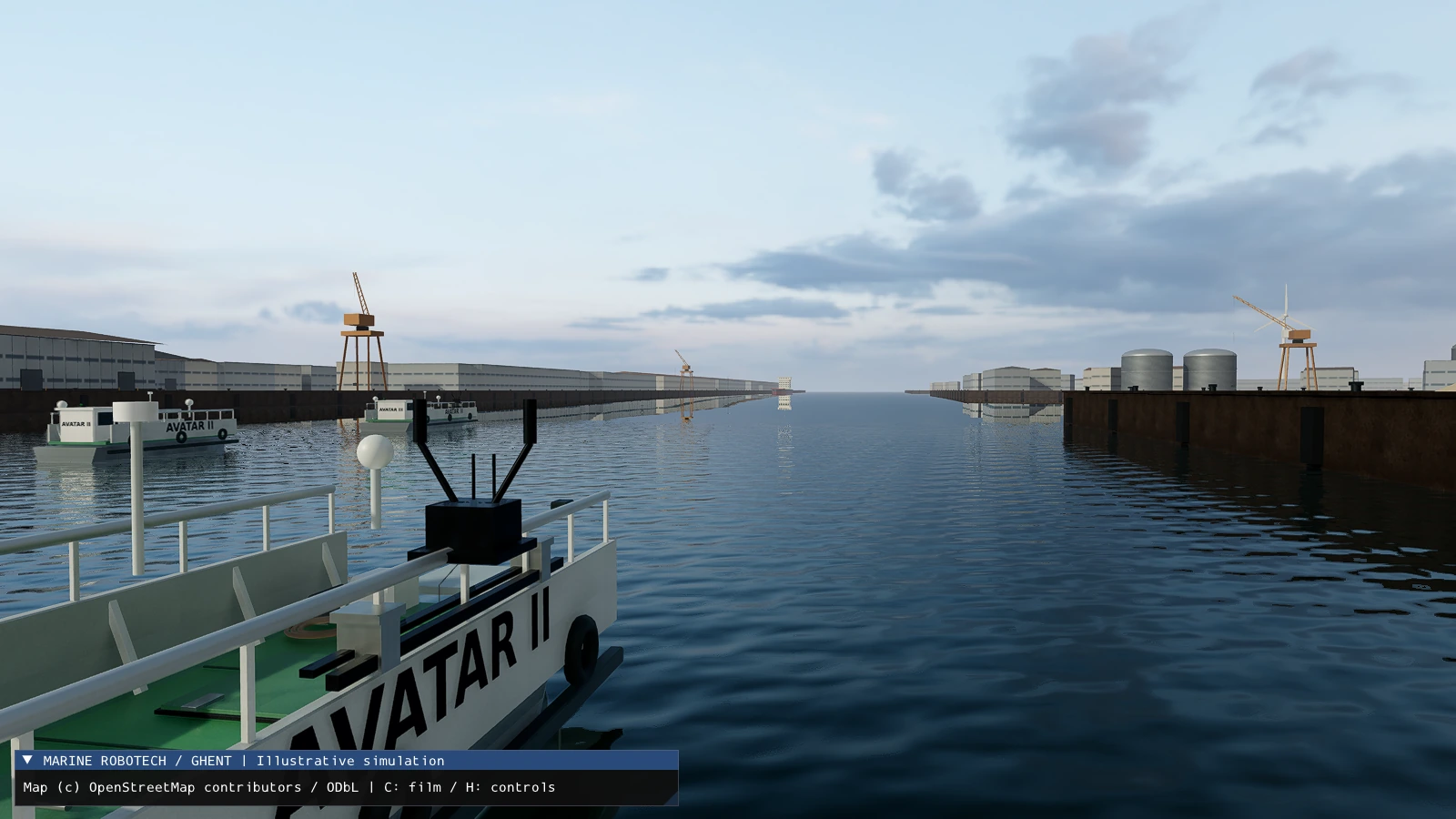
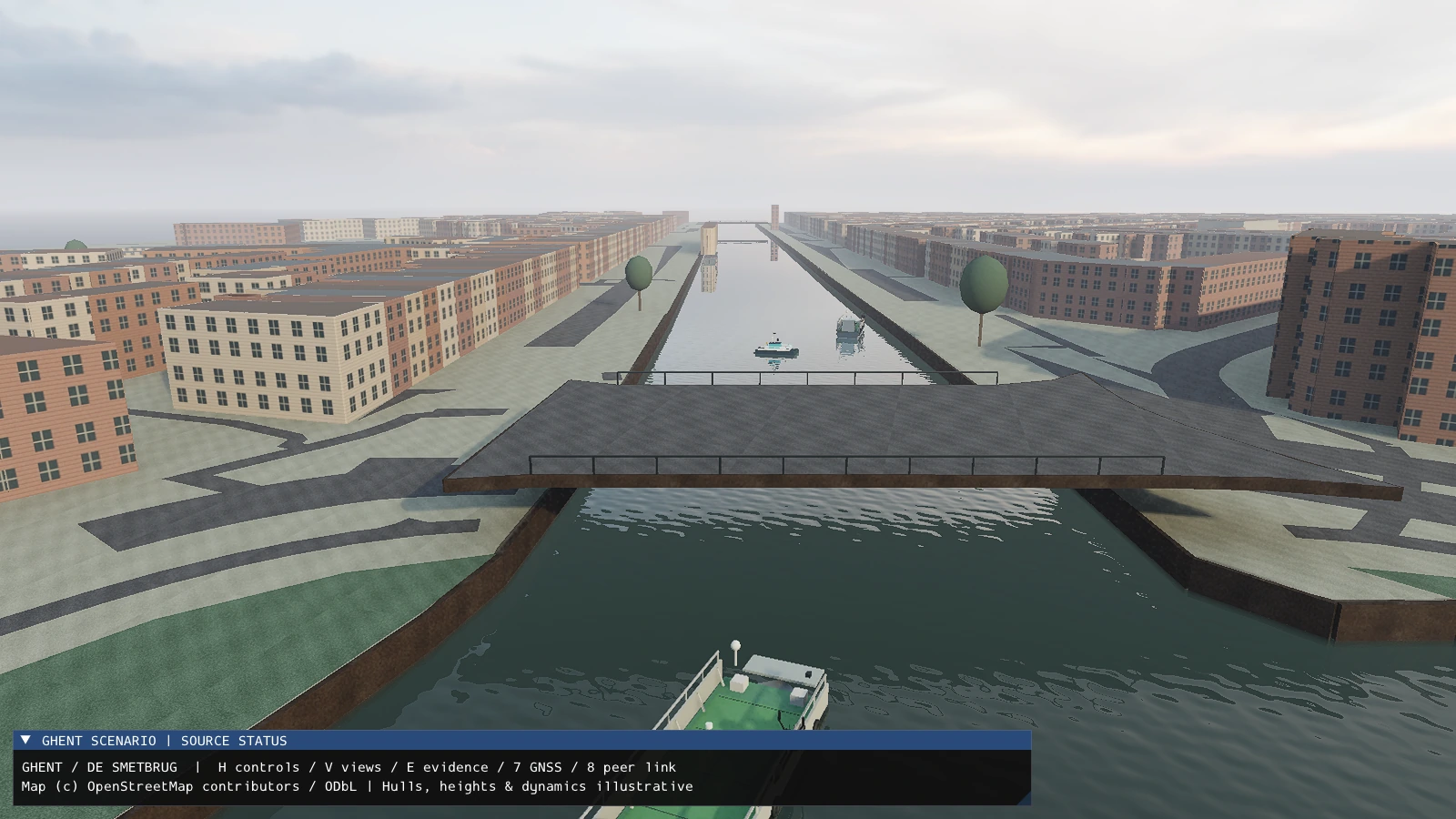
Map © OpenStreetMap contributors / ODbL.
PROPOSED OPERATOR EXPERIENCE
Combine position and heading with IMU measurements to display vessel movement, orientation and planned-versus-measured routes.
Add nearby observations, link status, operating mode and data age. Identify the last known state during an interruption.
Align sensor observations, vessel state and events on one timeline for operator review, diagnosis and trial evaluation.
PROPOSED R&D PROGRAMME
From mobilisation, with readiness reviews before vessel trials and autonomous operation.
Agree the vessel, operator, interfaces, operating limits and baseline.
Requirements & acceptance criteriaConnect the Marine Awareness System, vessel data and digital twin. Verify sensing, live displays and replay on the bench and while moored.
Integrated demonstratorTest awareness, initial fallback and reconnection during supervised low-speed trials. Review readiness for autonomous control.
Trial evidence & commissioning methodDevelop and test onboard navigation decisions and control during loss of the shore connection, within a defined operating envelope.
Bounded demonstrator & deployment assessmentThe scope, funding, partner participation and schedule remain to be agreed. Automatic vessel control has not been demonstrated by the current prototype.
PROPOSED RESILIENCE FUNCTIONS
The remote operations centre (ROC) and vessel need a predictable transition, bounded onboard behaviour and an explicit return of control.
Test command-link loss, GNSS loss and RTK-correction loss separately. Choose a vessel-specific fallback using the remaining capability.
The autonomy stage would use local maps, routes, sensing and limits to decide whether an authorised route segment can continue or recovery is needed.
Exchange state and event logs, confirm control authority and reject expired commands before remote control resumes.
Validation progresses from simulation and controller tests to supervised low-speed trials, with a responsible operator and local override.
START WITH A VESSEL & AN OPERATING QUESTION
A small survey or port-service vessel in a defined low-speed area is the proposed starting point. Ghent / North Sea Port is a candidate location, subject to vessel and site access.
Discuss a digital twin pilot